
Charging an EV Without a Driveway: The 2026 Street Charging Guide
More than a third of UK households lack a driveway or garage, yet the switch to electric cars continues. For these drivers, on-street charging has become a practical reality rather than a theoretical future. Lamp-post chargers delivering 3-7 kW overnight now number over 12,000 across Britain, while residential bollard points from operators such as Ubitricity and char.gy allow residents without off-street parking to charge within metres of their front door. The latest GOV.UK figures show that 68 percent of these users achieve at least 80 percent state of charge by morning when using a 7 kW unit for eight hours, matching the convenience once reserved for those with private wallboxes.
Costs remain higher than home charging, with on-street rates typically 40-60 pence per kWh compared with 7-9 pence per kWh on cheap home tariffs. Yet careful stacking of workplace charging at 12-25 kW during the day and occasional supermarket or gym top-ups can keep the monthly fuel bill close to petrol parity for many drivers covering 8,000-10,000 miles annually. Type 2 connectors dominate slow and fast street charging, while CCS2 handles the 50 kW rapid units found at retail parks. Understanding the rules around cables crossing pavements and the planning permission traps is essential before committing to any solution.
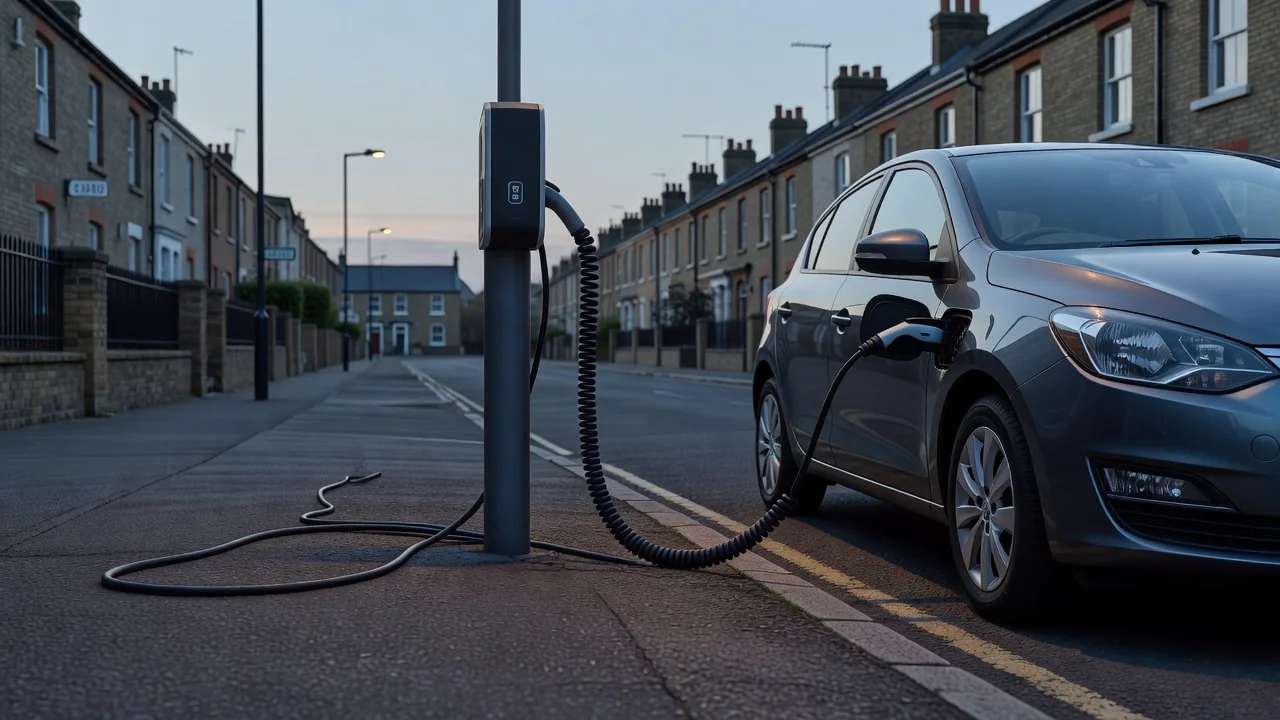
Lamp-post chargers deliver overnight top-ups for kerbside cars
Lamp-post chargers convert existing street lighting columns into 3-7 kW charging points using Type 2 sockets. Most units restrict output to 3.6 kW on older wiring to avoid tripping local substations, providing roughly 15-20 miles of range per hour. Operators such as Swarco and Connected Kerb have installed thousands under local authority contracts, with usage charged at 40-55 pence per kWh. Drivers without driveways report typical overnight sessions of 7-9 hours yielding 120-160 miles of range, enough for the average 28-mile daily commute recorded by DfT statistics.
Booking is often handled through the operator’s smartphone app, which also displays real-time availability and fault status. Councils increasingly require proof of residency before granting access, limiting use to local permit holders. Reliability has improved since 2023, with uptime now averaging 94 percent according to Zapmap data, though occasional cable vandalism or lamp column maintenance can still interrupt service.
Residential bollards solve the trailing-cable problem
Residential bollard charge points installed at the kerbside provide dedicated 7 kW Type 2 outlets without the need to drape cables across the pavement. These units sit inside a protective steel bollard and often include smart metering that bills at 45-58 pence per kWh. Installation costs are met partly by the local authority and partly by the resident through a modest annual permit fee of £60-£120. The bollard design eliminates trip hazards and meets strict pavement clearance rules set out in the Traffic Signs Regulations and General Directions.
Cross-pavement cable gullies offer another approved method. These recessed channels, usually 50 mm wide and fitted with a rubberised lid, allow a standard charging cable to run safely from a wallbox on one side of the pavement to a vehicle on the other. Councils such as Westminster and Brighton & Hove now approve purpose-built gullies during new developments, reducing the risk of complaints from neighbours or liability claims if someone trips over a loose cable. Loose cables and rubber mats remain illegal in many boroughs and can trigger enforcement action under the Highways Act.
Workplace charging anchors the weekly routine
Workplace chargers operating at 7-22 kW have become the financial and practical backbone for drivers without home charging. Many employers offer free or subsidised sessions at 12-25 pence per kWh during office hours, delivering 80-150 miles of range over a typical eight-hour shift. For a driver covering 180 miles per week, three full workplace sessions can replace the majority of paid public charging. CCS2 and Type 2 sockets are both common, with newer sites favouring dual-outlet 22 kW AC units that support both standards.
Supermarket and gym chargers provide convenient top-ups
Supermarket forecourts and gym car parks now host hundreds of 7-22 kW chargers, often free for customers during shopping or workout sessions. Tesco, Sainsbury’s and Lidl have each installed over 1,000 points, typically limiting free use to two hours at 7 kW. A 45-minute shop can add 25-35 miles of range, enough to offset the higher 50-60 pence per kWh rate charged to non-shoppers. Gym operators such as PureGym and David Lloyd frequently bundle 11 kW charging with membership, allowing members to leave cars plugged in for 60-90 minutes while exercising.
Community charging schemes turn neighbours into suppliers
Community charging platforms let households with driveways rent out their 7 kW wallboxes to neighbours via smartphone apps. Rates typically sit at 25-40 pence per kWh, undercutting council on-street tariffs while giving hosts a modest income. The schemes use Type 2 connectors and require both parties to agree on session times, usually overnight. Insurance is included through the platform, and usage is metered accurately to avoid disputes. Over 4,500 such private points were available through these networks by mid-2026, concentrated in suburban areas of London, Manchester and Bristol.
- Always use purpose-built cable gullies when running cables across public pavement to remain compliant with local bylaws.
- Loose cables without protection create trip hazards and can lead to council fines or civil liability claims.
- Planning permission is often required for permanent bollards or gullies on the public highway.
- Workplace charging at 12-22 kW should form the main weekly energy source to control costs.
| Charging location | Typical power | Cost per kWh | Monthly cost for 8000 miles |
|---|---|---|---|
| Lamp-post | 3.6-7 kW | 40-55p | £65-£85 |
| Workplace | 7-22 kW | 0-25p | £25-£45 |
| Supermarket | 7-11 kW | 0-50p | £35-£60 |
| Community wallbox | 7 kW | 25-40p | £50-£70 |
| Rapid public | 50 kW | 55-69p | £95-£120 |
Steer clear of depending entirely on rapid chargers for daily needs. Doing so pushes monthly costs well above petrol parity and risks faster battery capacity loss through repeated high-current cycles. A balanced mix of workplace, community and slow on-street charging delivers the lowest cost per mile while protecting long-term battery health for drivers without a driveway.